

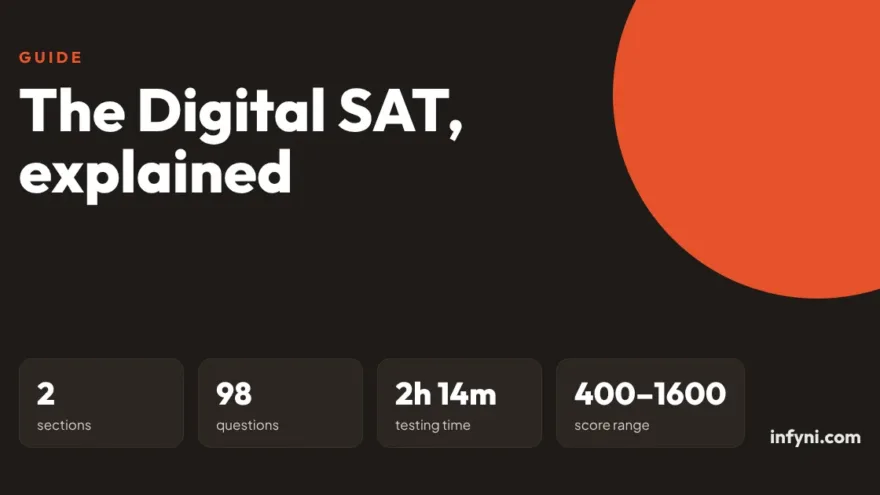
The SAT is now fully digital. It is shorter than the old paper test, takes 2 hours 14 minutes, and adapts its difficulty to how you’re doing. If you’re preparing with old paper-test books or advice from a few years ago, much of it no longer applies.
This guide explains how the Digital SAT works: what’s in each section, how the adaptive modules work, how it’s scored out of 1600, and how to practise for it. Every detail comes from College Board, the organisation that runs the SAT.
The Digital SAT at a glance
| Reading and Writing | Maths | |
|---|---|---|
| Questions | 54 | 44 |
| Time | 64 minutes | 70 minutes |
| Modules | 2 modules of 32 minutes | 2 modules of 35 minutes |
| Question format | Short passage, one multiple-choice question each | Multiple choice, plus questions where you type your own answer |
| Score | 200–800 | 200–800 |
The whole test takes 2 hours 14 minutes, with a 10-minute break between the two sections. Your total score is the two section scores added together, from 400 to 1600.
You take the test on College Board’s Bluebook app, on a Windows or Mac laptop or an iPad. Students without a suitable device can ask to borrow one from College Board when they register.
How the adaptive modules work
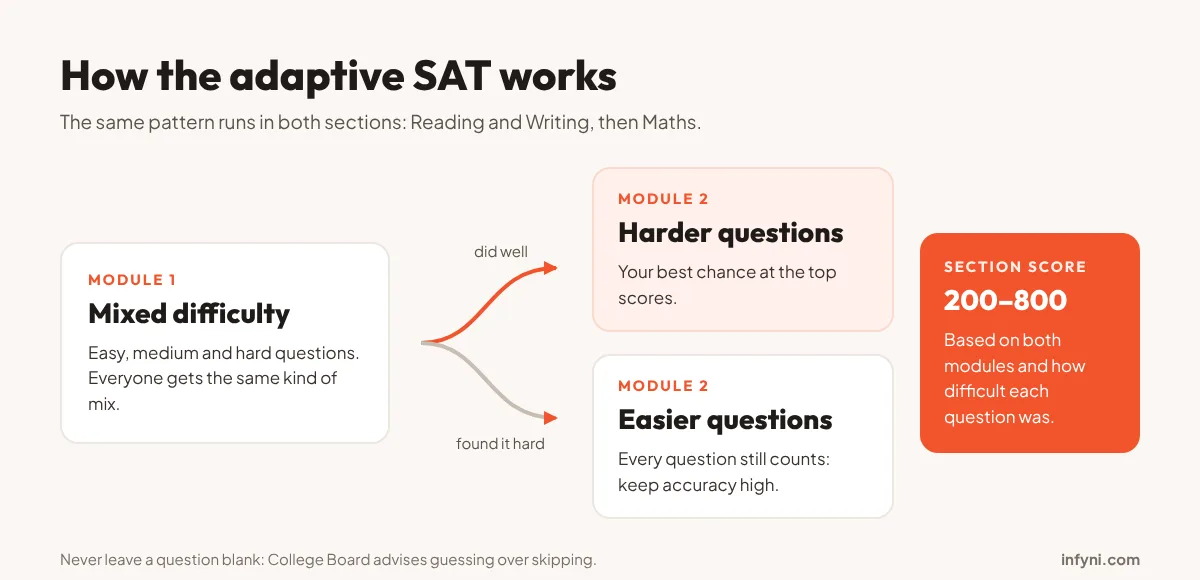
Each section is split into two modules, and the second one depends on how you do in the first.
- Module 1 has a broad mix of easy, medium, and hard questions. Everyone gets the same kind of mix.
- Module 2 is either harder or easier, depending on your performance in Module 1.
- Your section score is based on your answers across both modules, and on how difficult each question you answered was.
That has three practical consequences:
- Module 1 matters most. A strong first module opens the harder second module, which gives you the best chance at the top scores. Don’t treat it as a warm-up.
- A harder Module 2 is good news. If the second module feels tougher, that usually means you did well in the first.
- Never leave a question blank. College Board advises that guessing is better than leaving an answer empty, especially once you’ve ruled out one or two options.
Each module also includes two trial questions that College Board is testing for future exams. They don’t count towards your score, and you can’t tell which ones they are, so give every question your best effort.
The Reading and Writing section
Every question is a short passage of 25 to 150 words, sometimes a pair of passages, followed by a single multiple-choice question. Passages come from literature, history and social studies, the humanities and science. Some include a table or graph.
The questions fall into four areas:
| Area | Share of questions | What it tests |
|---|---|---|
| Craft and Structure | About 28% | Words in context, the purpose and structure of a text, connections between two texts |
| Information and Ideas | About 26% | Main ideas and details, inferences, using evidence from text, tables and graphs |
| Standard English Conventions | About 26% | Grammar and punctuation: sentence boundaries, verb and pronoun forms, agreement |
| Expression of Ideas | About 20% | Choosing the best transition, and combining notes into a sentence that meets a goal |
Within each module, questions on similar skills are grouped together and run from easiest to hardest.
How to practise Reading and Writing
- Learn the grammar rules. Standard English Conventions questions test a fairly small set of rules, such as commas, semicolons, colons and verb agreement. They are the quickest marks to gain.
- Read for the author’s purpose, not just the facts. Many questions ask why a sentence is there, or what a word means in that passage.
- Practise with graphs. Some evidence questions need you to read a table or chart against the text.
- Work in timed sets. You have about 71 seconds per question, so speed matters as much as accuracy.
The Maths section
The Maths section covers four areas, and algebra makes up most of it:
| Area | Share of questions | Topics |
|---|---|---|
| Algebra | About 35% | Linear equations and functions, systems of two linear equations, linear inequalities |
| Advanced Maths | About 35% | Non-linear functions and equations (such as quadratics and exponentials), equivalent expressions |
| Problem-Solving and Data Analysis | About 15% | Ratios, rates, percentages, data and statistics, probability |
| Geometry and Trigonometry | About 15% | Area and volume, lines, angles and triangles, right-angled triangles and trigonometry, circles |
Most questions are multiple choice. Some ask you to work out the answer and type it in yourself, so there are no options to check against. About 30% of questions are set in a real-world, science or social studies context.
Calculator and formulas: you can use a calculator for the whole Maths section. Bluebook has a built-in Desmos graphing calculator, or you can bring your own approved calculator. A reference sheet of common formulas is also built in.
How to practise Maths
- Secure the algebra first. Algebra and Advanced Maths together are about 70% of the section.
- Learn the Desmos calculator. Graphing an equation is often faster than solving it by hand. Practise with it in Bluebook before test day, so you know when it saves time.
- Practise typed answers. Typed-answer questions punish small slips, so check units and signs before you enter an answer.
- Watch the clock. You have about 95 seconds per question. If one is taking too long, mark it for review and come back.
How the Digital SAT is scored
Each section is scored from 200 to 800, and the two add up to your total of 400 to 1600.
The score isn’t simply a count of right answers. College Board’s scoring takes into account which questions you got right and how difficult each one was. Two students with the same number of correct answers can end up with different scores.
What’s a good SAT score? College Board’s answer is that it depends on where you’re applying. Each college has its own expected range. Look up the score range for every college on your list, and set your target from those.
Retaking helps. Many students take the SAT more than once, and on average they score higher the second time, with more practice and more familiarity with the format. How a college treats several sets of scores is up to the college, so check each one’s policy.
How to practise for the Digital SAT
Start with College Board’s own free material. It’s written by the people who write the real test:
- Full-length practice tests in Bluebook. These are adaptive, like the real SAT, and give you a score at the end. Take your first one before you start studying, so you know where you stand.
- The Student Question Bank. College Board’s question bank lets you filter practice questions by section, area and difficulty, which is ideal for drilling your weakest skills.
- Your practice score report. After each Bluebook test, the report shows how you did in each area. Use it to decide what to study next.
A simple routine that works:
- Take a full-length practice test and note your weakest two or three areas.
- Spend the next one to two weeks practising only those areas, in timed sets.
- Take another full-length test, compare the area scores, and repeat.
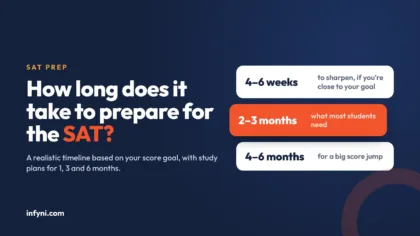
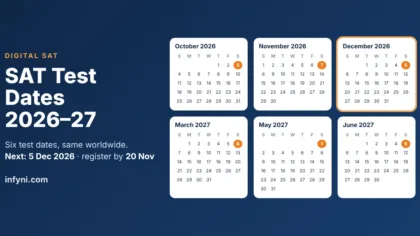
How long you need depends on your starting score and your test date. Our SAT test dates guide has week-by-week plans for each date in 2026–27.
Prepare with a live SAT instructor
Practice tests show you where you’re losing marks. A teacher helps you fix it, and keeps you on schedule until test day. Infyni’s live online SAT classes cover both sections of the Digital SAT:
- SAT English (Reading and Writing)
- SAT Maths
- Complete SAT course, both sections together
Not sure which one fits? Talk to our SAT team, and we’ll help you pick a course, a test date, and a study plan.
Frequently asked questions
How long is the Digital SAT?
Testing time is 2 hours 14 minutes: 64 minutes for Reading and Writing and 70 minutes for Maths, with a 10-minute break between them.
How many questions are on the Digital SAT?
98 in total: 54 in Reading and Writing and 44 in Maths. A few in each module are trial questions that don’t count towards your score.
Can I use a calculator on the Digital SAT?
Yes, on the whole Maths section. Bluebook has a built-in Desmos graphing calculator, or you can bring your own approved calculator.
How is the Digital SAT scored?
Each section is scored from 200 to 800, for a total of 400 to 1600. The score depends on which questions you answer correctly and how difficult they are, not just how many.
Is the Digital SAT adaptive?
Yes. Each section has two modules, and how you do in the first module decides whether the second is harder or easier.
Is there a penalty for wrong answers?
College Board advises guessing rather than leaving a question blank, so always enter an answer.
Where can I find official SAT practice tests?
Full-length adaptive practice tests are free in College Board’s Bluebook app.