

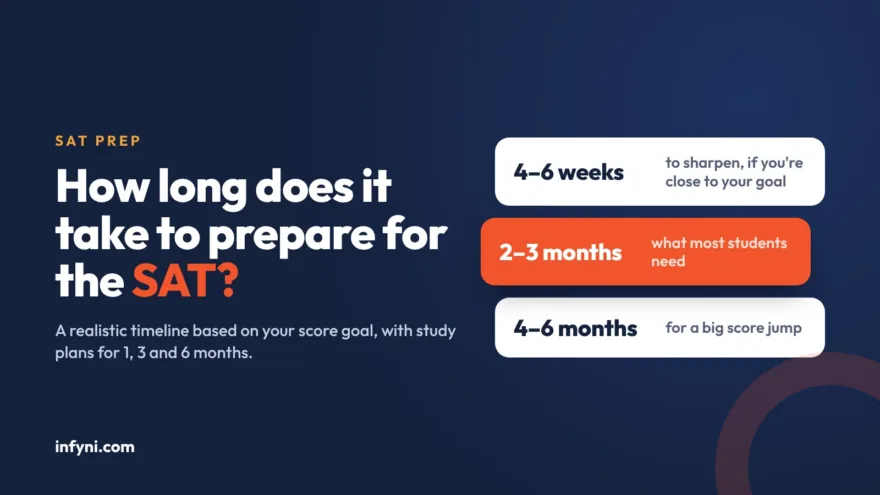
Most students need 2 to 3 months of steady practice to prepare for the SAT. If you’re already close to your target score, 4 to 6 weeks of focused work can be enough. If you’re starting from scratch or aiming for a big jump, give yourself 4 to 6 months.
The right timeline depends on four things: where your score is now, where it needs to be, when you’re taking the test, and how busy school is. This guide helps you work out your own timeline, with study plans for 1, 3 and 6 months.
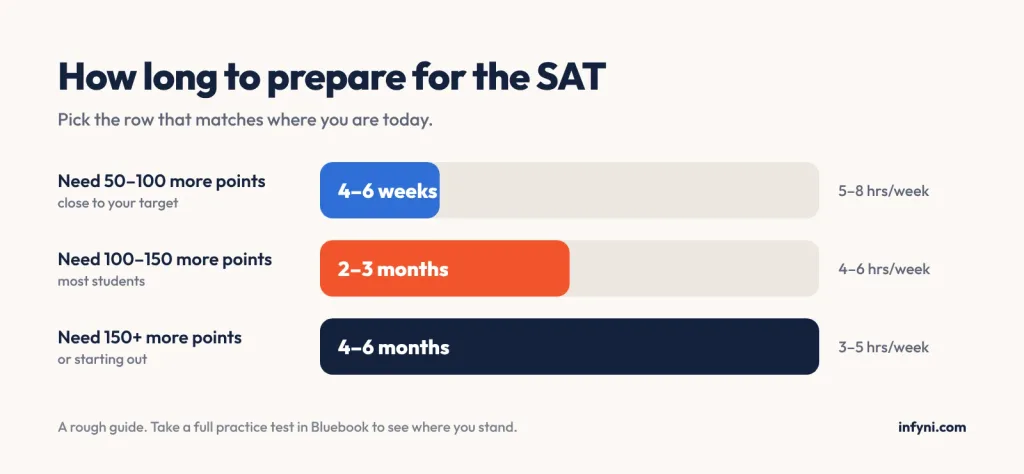
How long you need, at a glance
| Where you are | Time to allow | Study time per week |
|---|---|---|
| Close to your target, need 50 to 100 more points | 4 to 6 weeks | 5 to 8 hours |
| Need 100 to 150 more points | 2 to 3 months | 4 to 6 hours |
| Starting out, or need 150+ more points | 4 to 6 months | 3 to 5 hours |
Treat this as a rough guide, not a rule. Some students improve quickly once they learn the test’s format; others need longer on one weak area. The only way to know where you stand is to take a full practice test, which is step one below.
What College Board recommends
College Board, which runs the SAT, suggests practising 15 to 30 minutes a few days each week in the months before the test. Its research links 6 to 8 hours of study on Official SAT Practice with an average 90-point score increase, and 20 hours with an average 115-point increase (College Board).
The takeaway: short, regular sessions over several weeks beat a few long cramming sessions just before test day.
Four things that decide your timeline
1. Your starting score
Take one full-length, timed practice test before you plan anything. College Board’s free Bluebook app has official full-length practice tests that work exactly like the real Digital SAT, adaptive modules included. Your result tells you how far you are from your goal and which section needs more work.
2. Your target score
Look up the middle 50% SAT range for each college on your list, usually on its admissions page. Aim for the upper half of that range at the colleges you most want. The gap between your practice score and that target is what your prep time needs to close.
3. Your test date
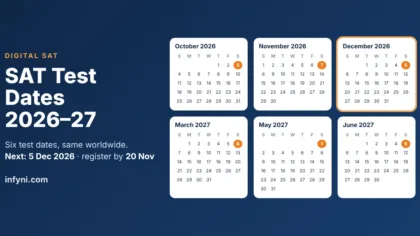
Count back from the test you’re aiming for. The next SAT dates are:
| Test date | Registration deadline | Prep time from mid-November |
|---|---|---|
| 5 December 2026 | 20 November 2026 | About 3 weeks |
| 6 March 2027 | 19 February 2027 | About 3½ months |
| 1 May 2027 | 16 April 2027 | About 5½ months |
| 5 June 2027 | 21 May 2027 | About 6½ months |
Dates are the same in the US, India and the UAE. For late registration deadlines and how to pick the right date for your grade, see our full guide to SAT test dates for 2026–27.
4. Your school workload
Plan around your busiest weeks. CBSE board exams usually run from February to April, and AP exams are held in May. If your SAT date falls close to these, start earlier so your heaviest SAT practice doesn’t clash with school exams.
Study plans for 1, 3 and 6 months
If you have 1 month (the December SAT)
One month is enough to sharpen, not to build from scratch. Focus on the format and on your most common mistakes.
- Week 1: take a full practice test in Bluebook, then go through every wrong answer and note why you got it wrong.
- Weeks 2 and 3: practise your two or three weakest question types every day, and do one timed module every other day.
- Week 4: take a second full practice test early in the week, review it, then keep sessions light. Rest the day before the test.
If you have 3 months (the March SAT)
This is the timeline most students need, and it leaves room to fix weak areas properly.
- Month 1: take a practice test, then rebuild the basics you’re missing: algebra and grammar rules come up again and again.
- Month 2: move to mixed, timed practice. Take a full practice test every two weeks and review each one.
- Month 3: take a full test every week or two under real conditions, and spend most of your time on review rather than new material.
If you have 4 to 6 months (the May or June SAT)
A longer runway suits Grade 11 students taking their first SAT, or anyone aiming for a big jump.
- First two months: build skills steadily, 3 to 4 hours a week, alongside schoolwork.
- Middle months: add timed practice and a full test once a month to track progress.
- Last six weeks: switch to full tests every one to two weeks and targeted review.
Many students take the SAT twice. A first attempt in spring of Grade 11 leaves time for a retake in August to October of Grade 12, still in time for early applications.
Mistakes that waste prep time
- Using old paper-SAT books. The Digital SAT has shorter passages, adaptive modules, and a different timing. Stick to material made for the digital test.
- Practising untimed only. Knowing how to solve a question isn’t enough if you can’t do it in the time allowed.
- Skipping review. Taking test after test without studying your mistakes rarely moves your score.
- Ignoring the built-in calculator. Bluebook includes a Desmos graphing calculator for the whole Maths section. Learn to use it before test day.
- Cramming in the final week. Last-minute marathons tire you out. Keep the last few days light.
Free resources to start with
Two official resources cost nothing: the Bluebook app for full-length practice tests, and College Board’s free Digital SAT prep course on Khan Academy, with thousands of practice questions, videos, and lessons. Start there before buying anything.
Prepare with a live SAT instructor
Free resources give you questions. A teacher gives you a plan: what to study first, how to fix the mistakes you keep making, and how to stay on track until test day. Infyni’s live online SAT classes cover both sections of the Digital SAT:
- SAT English (Reading and Writing)
- SAT Maths
- Complete SAT course, both sections together
Not sure how long you need? Talk to our SAT team, and we’ll help you pick a test date and a study plan that fits.
Frequently asked questions
Is one month enough to prepare for the SAT?
It can be, if you’re already close to your target score and mainly need to learn the format and fix common mistakes. For a jump of more than about 100 points, most students need 2 to 3 months.
How many hours should I study for the SAT?
Most students do well with 3 to 6 hours a week over 2 to 3 months. College Board’s research links 20 hours of study on Official SAT Practice with an average 115-point increase.
When should I start preparing for the SAT?
Most students start in Grade 11, 3 to 6 months before their first test date. Starting in Grade 10 with the PSAT and steady maths and reading practice makes the main prep period easier.
How many practice tests should I take?
Plan on two full practice tests for a one-month plan and three or more for longer plans, spaced out so you have time to review each one. Reviewing a test properly matters more than taking more of them.
Can I prepare for the SAT on my own?
Yes. The Bluebook practice tests and the free Khan Academy course are a strong start. Many students add a teacher for structure, feedback on mistakes, and help staying on schedule.
When is the next SAT?
The next SAT is on 5 December 2026. Registration closes on 20 November, and late registration closes on 24 November. After that, the next SAT is on 6 March 2027.