

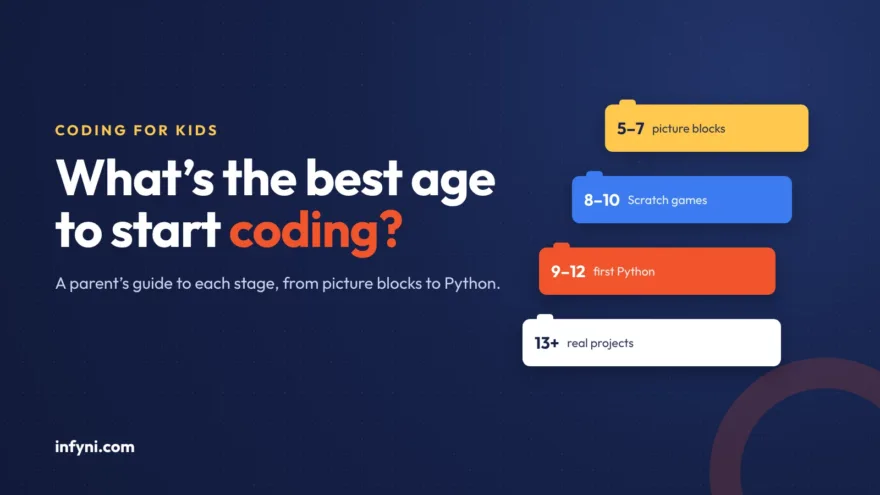
There’s no single perfect age, but most children can start coding at 5 to 7 with picture-based tools, move on to Scratch around 8, and pick up a typed language like Python between 9 and 12. Starting earlier doesn’t guarantee a head start, and starting at 13 or 15 is not too late.
What matters more than the number is whether your child is ready for the kind of coding in front of them. This guide walks through each stage, the signs that your child is ready, and how to begin without pushing too hard.
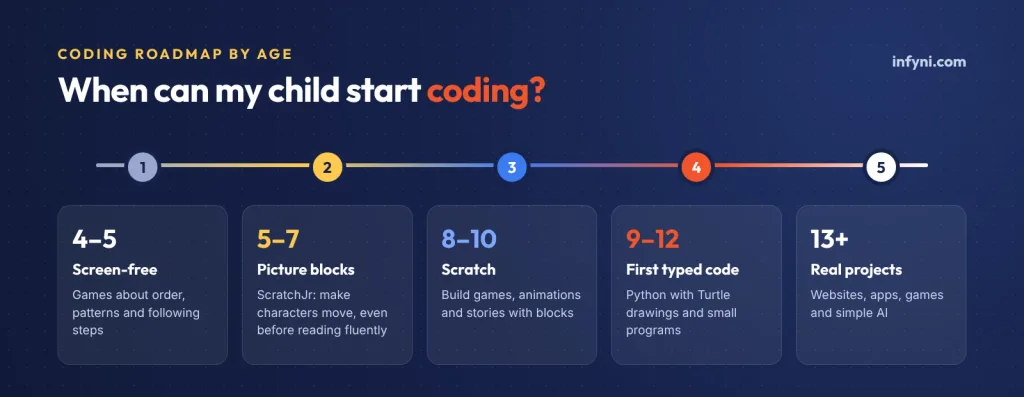
Coding by age, at a glance
| Age | What coding looks like | Good places to start |
|---|---|---|
| 4 to 5 | Screen-free games about order, patterns and following steps | Board games, treasure hunts, giving step-by-step directions |
| 5 to 7 | Snapping picture blocks together to make characters move and talk | ScratchJr |
| 8 to 10 | Building games, animations and stories with drag-and-drop blocks | Scratch |
| 9 to 12 | A first typed language, drawing shapes and making small programs | Python with Turtle graphics |
| 13 and up | Real projects: websites, apps, games and simple AI | Python, HTML, CSS, JavaScript |
The age bands overlap on purpose. A confident reader of 7 may be happy in Scratch, while a 10-year-old who has never coded will still enjoy starting with blocks before moving on to typing.
Each stage, explained
Ages 4 to 5: coding without a screen
Coding is really about breaking a task into clear steps and putting them in the right order. Young children practise this all the time without a computer: guiding a friend across the room with “two steps forward, turn left”, following a recipe, or spotting the pattern in a row of beads. If your preschooler loves these games, they’re already building the thinking that coding needs.
Ages 5 to 7: picture blocks
This is the earliest age most children can code on a device. ScratchJr, a free app from the team behind Scratch, is built for ages 5 to 7. Its blocks use icons rather than words, so children can make characters move, jump, and sing before they read fluently. Short sessions work best here, and the goal is play, not lessons.
Ages 8 to 10: Scratch
Scratch is where most children start coding properly. The Scratch Foundation recommends it from age 8, and it’s free to use in a browser. Children drag and drop blocks to build games, animations and stories, and along the way they learn loops, conditions, variables and debugging. These ideas carry straight over to every “real” programming language later.
Ages 9 to 12: a first typed language
Once a child types comfortably and has outgrown blocks, Python is a natural next step. Its code reads almost like plain English, and with the built-in Turtle module, children can draw shapes and patterns from their first lesson, so they see results straight away. Typing mistakes are part of this stage. Learning to read an error message and fix it calmly is one of the most useful things a child can learn.
Ages 13 and up: real projects
Teenagers can go deeper into Python, build websites with HTML, CSS and JavaScript, and try app or AI projects. Teens who start now often move quickly, because they already have the reading, maths and patience that younger children are still building.
Signs your child is ready
Readiness shows up in behaviour more than in birthdays. Your child is probably ready to try coding if they:
- enjoy puzzles, building toys or games with rules
- ask how games or apps work, or want to make their own
- can follow instructions with three or four steps
- can stick with something for 15 to 20 minutes
- read fairly fluently (for Scratch) or type comfortably (for Python)
If your child gets frustrated quickly or loses interest, that isn’t a sign they’re “not a coder”. It usually means the tool is a level too hard. Step back to blocks or screen-free games for a few months and try again.
Is it ever too late to start?
No. Plenty of strong programmers wrote their first line of code in high school, college, or later. A 14-year-old beginner can skip the block stage entirely and start with Python. Starting young helps mainly because it makes coding feel familiar and fun, not because there’s a cut-off age.
What schools teach
In India, the National Education Policy 2020 brings coding into the middle stage, from Class 6, and CBSE offers coding as a skill module in Classes 6 to 8. In the US, computer science in elementary and middle school varies a lot by state and district, so it’s worth asking your child’s school what they cover. Either way, school lessons tend to be short, which is why many families add a class or club for children who enjoy it.
How to get started
- Try a free tool together. Spend half an hour with ScratchJr or Scratch and make something silly, like a cat that dances when you click it.
- Watch, don’t steer. Notice whether your child asks to do it again. Enjoyment is the best predictor of whether they’ll stick with it.
- Follow their interests. A child who loves stories can animate one; a child who loves football can build a penalty-shootout game.
- Add a teacher when they’re ready for more. A live teacher helps children get unstuck, keeps them moving through new ideas in order, and gives them projects to finish.
- Focus on projects, not languages. Finishing small games and animations builds more confidence than rushing from one language to the next.
Coding classes for kids at Infyni
Infyni runs live online coding classes for children at different stages:
- Live Scratch/Block coding: a beginner group course where children build interactive stories and games
- Fun Scratch coding for kids: one-to-one Scratch sessions
- Python for beginners (Grades 3 to 5): a first typed language for ages 8 to 11, including Turtle drawings and a mini project
- AI with Scratch: an introduction to AI ideas using Scratch
Not sure where your child should start? Talk to our team, and we’ll help you pick the right level.
Frequently asked questions
What is the best age for a child to start coding?
Most children can start between 5 and 7 with picture-based tools like ScratchJr. Around 8, they’re usually ready for Scratch, and between 9 and 12, many move on to a typed language like Python.
Can a 5-year-old learn coding?
Yes, in a playful way. ScratchJr is designed for ages 5 to 7 and uses picture blocks, so children can code before they read fluently. Screen-free games about sequences and patterns work well too.
What age should a child learn Python?
Usually between 9 and 12, once they type comfortably and have some experience with block coding. Older beginners can start with Python straight away.
Is 13 too late to start coding?
Not at all. Teenagers often learn faster than younger children because they read, reason and handle mistakes more easily. A 13-year-old can start directly with Python or web development.
Should my child start with Scratch or Python?
Under about 10, start with Scratch, which lets children focus on ideas instead of typing. From around 10 or 11, a child who types well can begin with Python, especially if they have tried Scratch before.
Do schools in India teach coding?
Under the National Education Policy 2020, coding is introduced in the middle stage, from Class 6. CBSE offers coding as a skill module in Classes 6 to 8.