

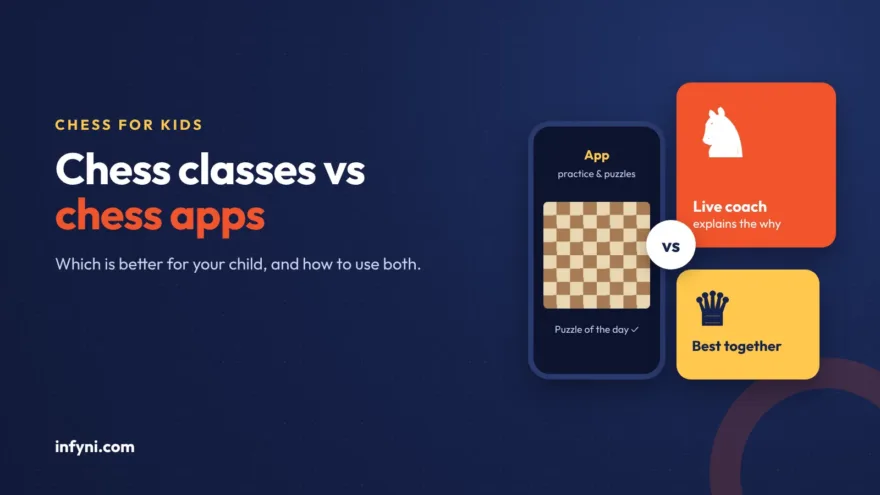
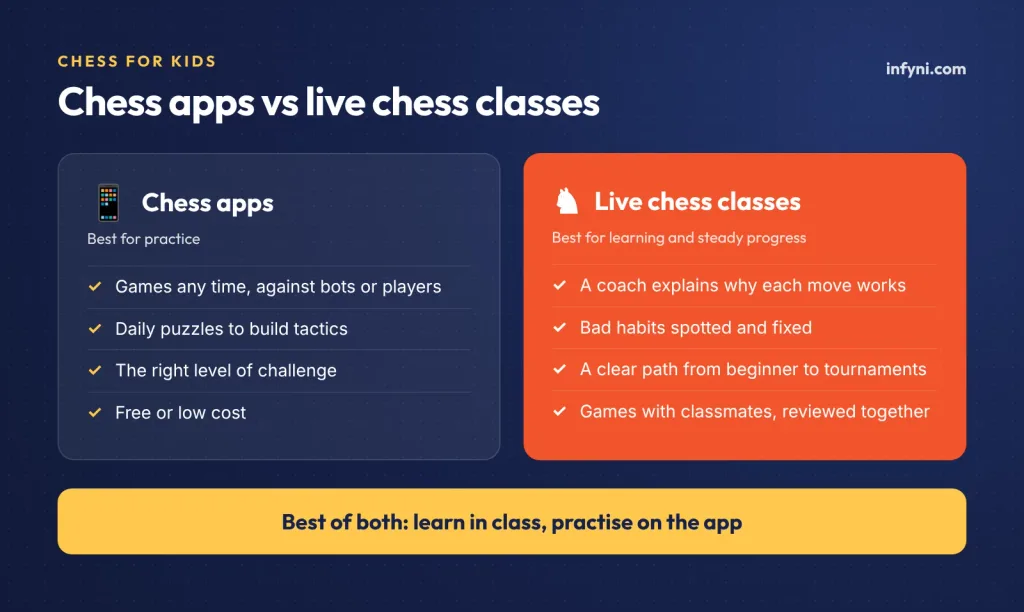
Chess apps are brilliant for practice: endless games, daily puzzles, and opponents at any level, often for free. What they can’t do is explain why a move works, spot the habit that keeps costing your child games, or help them through a frustrating loss. That’s where a live chess class comes in.
For most children, the best answer isn’t one or the other. A class teaches the ideas, and an app gives them a place to practise. This guide compares the two side by side, shows which one your child needs right now, and explains how to use both without adding hours of screen time.
Chess classes vs chess apps at a glance
| Chess apps | Live chess classes | |
|---|---|---|
| How your child learns | Videos, puzzles and playing games, mostly on their own | A coach teaches live, and kids ask questions as they go |
| Explaining the “why” | Shows the best move, rarely why it works | The coach explains the idea behind each move |
| Feedback on mistakes | Flags blunders after the game | Spots habits and shows how to fix them |
| Structure | Your child chooses what to do next | A step-by-step path from beginner to tournament level |
| Motivation | Streaks, badges and ratings | A coach, classmates and goals to work towards |
| Playing others | Strangers online, often at fast speeds | Classmates at the same level, with games reviewed together |
| Cost | Free or a low monthly fee | A course fee, usually with a free trial |
| Best for | Daily practice and puzzles | Learning the game properly and improving steadily |
What chess apps do well
Apps have changed how children practise chess, and they deserve credit. Popular options include Chess.com, Lichess, which is free with no ads, and ChessKid, Chess.com’s site made for children. Good apps give your child:
- Games any time. There’s always an opponent, a bot or a friend ready to play.
- Puzzles. A few minutes of tactics a day is one of the best habits a young player can build.
- The right level of challenge. Bots and ratings keep games close, so children win sometimes and lose sometimes.
- Low or no cost. Most of what a beginner needs is free.
Where apps fall short for children
An app is a tool, not a teacher. On their own, children often run into the same problems:
- No one explains why. The app shows the best move, but a child who doesn’t understand the idea behind it will repeat the same mistake in the next game.
- Bad habits go unnoticed. Moving too fast, bringing the queen out early or ignoring the opponent’s threats can go on for months without anyone pointing them out.
- Speed over thinking. Many children drift to very fast games, which reward quick hands more than careful thought.
- Losing streaks hurt. Five losses in a row with no one to talk them through it is a common reason children give up.
- Strangers and chat. Open online play means meeting players your child doesn’t know, so settings matter.
What a live chess class adds
A good class does the parts an app can’t:
- The ideas behind the moves. A coach shows each idea move by move and checks that your child understands it before moving on.
- Feedback on how they think. Coaches notice habits, like rushing or missing threats, and give your child a simple routine to fix them.
- A clear path. Lessons build in order: how the pieces move, then checkmates, tactics, openings, strategy and endgames.
- Real games, reviewed together. Playing classmates at the same level and going over the game afterwards turns every loss into a lesson.
- Patience and sportsmanship. Children learn to sit with a hard problem, win graciously and lose without giving up.
Which one does your child need right now?
Curious beginners (around 5 to 8)
Start with a coach. Young children learn the rules faster when someone shows them, and they stay interested when chess feels like a game with a friendly adult rather than a screen. Keep app time short and stick to simple puzzles.
Kids who know the rules but have stopped improving
This is where a class makes the biggest difference. Most plateaus come from habits and gaps in understanding, and those are hard to see from the inside. A coach can spot them in a single game.
Children aiming for tournaments
They need both: regular lessons for openings, strategy and endgames, plus plenty of practice games and puzzles. Coaches also help with things apps don’t teach, like managing the clock and staying calm after a mistake.
Casual players
If your child just enjoys an occasional game with family, an app with puzzles and friendly bots may be all they need.
How to use classes and apps together
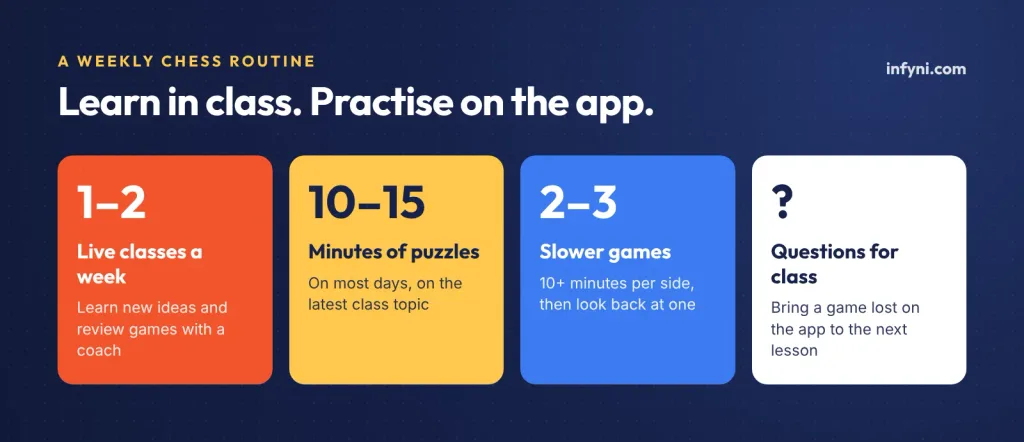
The strongest young players use a class to learn and an app to practise. A simple weekly routine:
- One or two live classes a week to learn new ideas and review games with a coach.
- 10 to 15 minutes of puzzles on most days, on the topic from the latest class if the app allows it.
- A few slower games a week (10 minutes or more per side), then look back at one of them.
- Bring questions to class. A game your child lost on the app is perfect material for the next lesson.
Keeping app time healthy
- Choose a child-friendly app or account, and turn off chat with strangers.
- Set slower time controls, so games reward thinking rather than speed.
- Agree on a daily limit, and count chess as part of overall screen time.
- Play with your child sometimes. It’s the easiest way to see how they’re getting on.
Live chess classes for kids at Infyni
Infyni runs live online chess classes for children aged 6 to 14, taught by real coaches, not videos. Classes are in small groups or one-to-one, and the trial class tells us your child’s level so they start with children at the same stage.
- Four levels, from Pawn (complete beginners) to Queen (ready for rated tournaments)
- Experienced coaches, including an Arena Grandmaster with 10+ years of coaching
- Real results: our students have placed at tournaments in the US, including a third-place finish at a US Chess Federation K-2 Grade Championship in Michigan
- Batches for students in India, the Middle East, and North America
The trial class is free, and you only pay if you decide to continue.
Frequently asked questions
Are chess apps good for kids?
Yes, for practice. Apps give children puzzles and games at the right level any time they want. They work best alongside a teacher who can explain ideas and correct habits.
Can a child learn chess from an app alone?
A child can learn the rules and improve a little from an app. Most children improve faster and stay interested longer with a coach, because apps rarely explain why a move works or spot repeated mistakes.
What age should a child start chess classes?
Many children start between 5 and 8, once they can sit and focus for 20 to 30 minutes. Older beginners can start at any age. Infyni’s classes are for children aged 6 to 14.
How often should my child have chess classes?
One or two classes a week, plus a few minutes of puzzles on most days, works well for most children. Children preparing for tournaments usually practise more.
Are online chess classes as good as in-person ones?
They can be. In a live online class, the coach and children share the same board on screen, the coach explains ideas move by move, and children ask questions in real time, just as they would in a room.
Which chess app is best for kids?
Look for an app with puzzles, bots at different levels and safe settings. ChessKid is made for children, and Lichess is free with no ads. Whichever you choose, turn off chat with strangers.